Knowledge Spaces vs. Traditional Document Portals
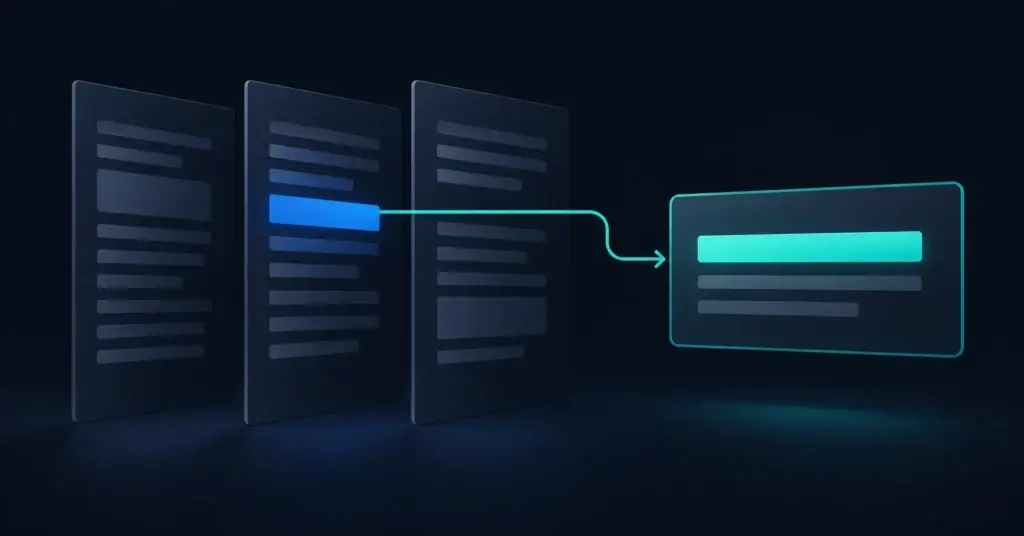
Many document platforms now offer AI assistants. Evaluate whether the existing platform meets the task before adding another layer.
 Knowledge Spaces
Applications
Governance
Delivery
Advisory
Industries
Government and Teaming
Company
Contact
Contact
Scope a Six-Week Pilot

Every organization adopting AI eventually hits the same question: how do we make this model actually useful for our work? The generic out-of-the-box experience is impressive, but it does not know your policies, your data, or your domain. Three approaches exist to close that gap, prompt engineering, retrieval-augmented generation (RAG), and fine-tuning, and the Sprinklenet team finds that most technical leaders are unclear on when to reach for which one.
This post is a practical decision guide. No hype, no silver bullets, just a clear framework for choosing the right approach (or, more likely, the right combination) for your use case.
Before diving into trade-offs, here is what each approach actually does at a mechanical level.
Prompt engineering is the practice of carefully crafting the instructions, context, and examples you provide to a model at query time. The model itself does not change. You are steering its existing capabilities through well-structured input, system prompts, few-shot examples, output format specifications, and guardrails.
Think of it as writing a detailed brief for a highly capable analyst. The analyst’s skills remain the same; your brief determines what they focus on and how they deliver the result.
Retrieval-augmented generation pairs a language model with a search layer. When a user asks a question, the system first retrieves relevant documents from your knowledge base, policies, reports, databases, internal wikis, and feeds those documents to the model alongside the question. The model then generates an answer grounded in your actual data. For a deeper technical explanation, the Sprinklenet team covered this in detail in What Is RAG? How Retrieval-Augmented Generation Powers Enterprise AI.
Think of it as giving that analyst a filing cabinet full of your organization’s documents and saying, “answer based on what you find here.”
Fine-tuning takes a pre-trained model and continues training it on your specific dataset. The model’s weights actually change. After fine-tuning, the model has internalized patterns, terminology, and reasoning styles from your data. It does not need to be told how to behave in your domain because it already knows.
Think of it as sending that analyst through a six-month immersion program in your industry before they start working.
Prompt engineering is the right starting point in almost every case. It is the fastest to implement, the cheapest to iterate on, and the easiest to maintain. The Sprinklenet team recommends it as the default first move for any AI initiative.
Prompt engineering is the best fit when:
Limitations: Prompt engineering cannot teach the model facts it does not already know. It cannot reliably inject large volumes of context (context windows are large but not infinite), and it cannot change the model’s fundamental reasoning patterns.
RAG is where most enterprise use cases land, and for good reason. Organizations have proprietary data that changes, compliance requirements that demand traceability, and security boundaries that cannot be crossed.
RAG is the best fit when:
Limitations: RAG requires infrastructure, vector databases, embedding pipelines, document processing, and retrieval tuning. The quality of answers depends heavily on the quality of retrieval. Poor chunking strategies or weak embeddings produce poor results regardless of how capable the model is.
Fine-tuning is the most powerful approach but also the most expensive, the slowest to implement, and the hardest to maintain. The Sprinklenet team advises reaching for it only after prompt engineering and RAG have been explored and found insufficient.
Fine-tuning is the best fit when:
Limitations: Fine-tuned models are frozen in time, they reflect the data they were trained on and require retraining to incorporate new information. The process demands curated training datasets, compute resources, and evaluation pipelines. Poorly executed fine-tuning can degrade a model’s general capabilities, a phenomenon known as catastrophic forgetting.
In practice, the best production AI systems do not choose one approach. They combine all three. This is not a compromise; it is an architecture decision. Each layer addresses a different dimension of the problem.
The Sprinklenet team’s experience across government and commercial AI deployments confirms this pattern consistently. Organizations that try to solve everything with one approach, over-engineering prompts to compensate for missing knowledge, or fine-tuning when RAG would suffice, end up with brittle, expensive systems that are difficult to maintain.
For a deeper look at how multiple models and approaches work together in production, see the Sprinklenet team’s post on Multi-LLM Orchestration.
When evaluating which approach fits your use case, work through these five questions:
For most organizations, particularly those in government, defense, and regulated industries, the answer is: start with prompt engineering, build RAG for knowledge access, and add fine-tuning only when the first two approaches leave a measurable gap.
Knowledge Spaces, Sprinklenet’s enterprise AI platform, was designed around this exact layered architecture.
The platform is RAG-first. Organizations connect their document repositories, and Knowledge Spaces handles ingestion, chunking, embedding, and retrieval automatically. Every response cites its sources. Access controls ensure users only retrieve what they are authorized to see.
Prompt engineering guardrails are built into every workspace. Administrators define system-level instructions that govern tone, format, compliance boundaries, and task-specific behavior, without writing code. These guardrails operate consistently across all interactions within a workspace.
Multi-model routing means Knowledge Spaces is not locked to a single AI provider. The platform routes queries to the most appropriate model for the task, including fine-tuned models when an organization has invested in domain-specific training. This flexibility ensures that as your AI maturity grows, the platform grows with you.
The result is a system where prompt engineering, RAG, and fine-tuning are not competing strategies but complementary layers, each doing what it does best.
Use prompting when the model already has the knowledge. Use RAG when the answer must come from current or private sources. Use fine-tuning when behavior, tone, extraction style, or domain-specific output needs to become consistent across many examples.
For the integration layer behind these choices, read AI systems integration services.

Many document platforms now offer AI assistants. Evaluate whether the existing platform meets the task before adding another layer.
A citation should let the reader inspect the passage that supports a claim.
Fine-tuning teaches a model how to behave, not what is true.
Most weeks I send one short read on enterprise AI: what’s working in real deployments, what’s not, and what I’d do in your seat.
Jamie Thompson, Founder and CEO