

Governed AI for Financial Institutions, Regulators, and Public Finance
Banks, credit unions, insurers, asset managers, payments companies, and the regulators who examine them hold themselves to documented controls, auditable records, and strict vendor risk management. Sprinklenet builds and operates AI applications that fit your existing policies, as a managed service or in your own environment.
Starting Points for Financial Institutions
Financial institutions answer to model risk management guidance, fair lending law including the Equal Credit Opportunity Act, and examiners who expect documented controls and validation evidence. Sprinklenet starts with staff-facing workflows where a named person stays accountable, each scoped as a pilot under your institution's existing policies.
- Examination PreparationCited answers from current policies, procedures, and prior findings, with the source attached for the examiner.
- Policy and Procedure SearchStaff ask in plain language and receive answers cited to approved documents.
- Third-Party and Vendor RiskKnowledge Spaces VRMS, covered below.
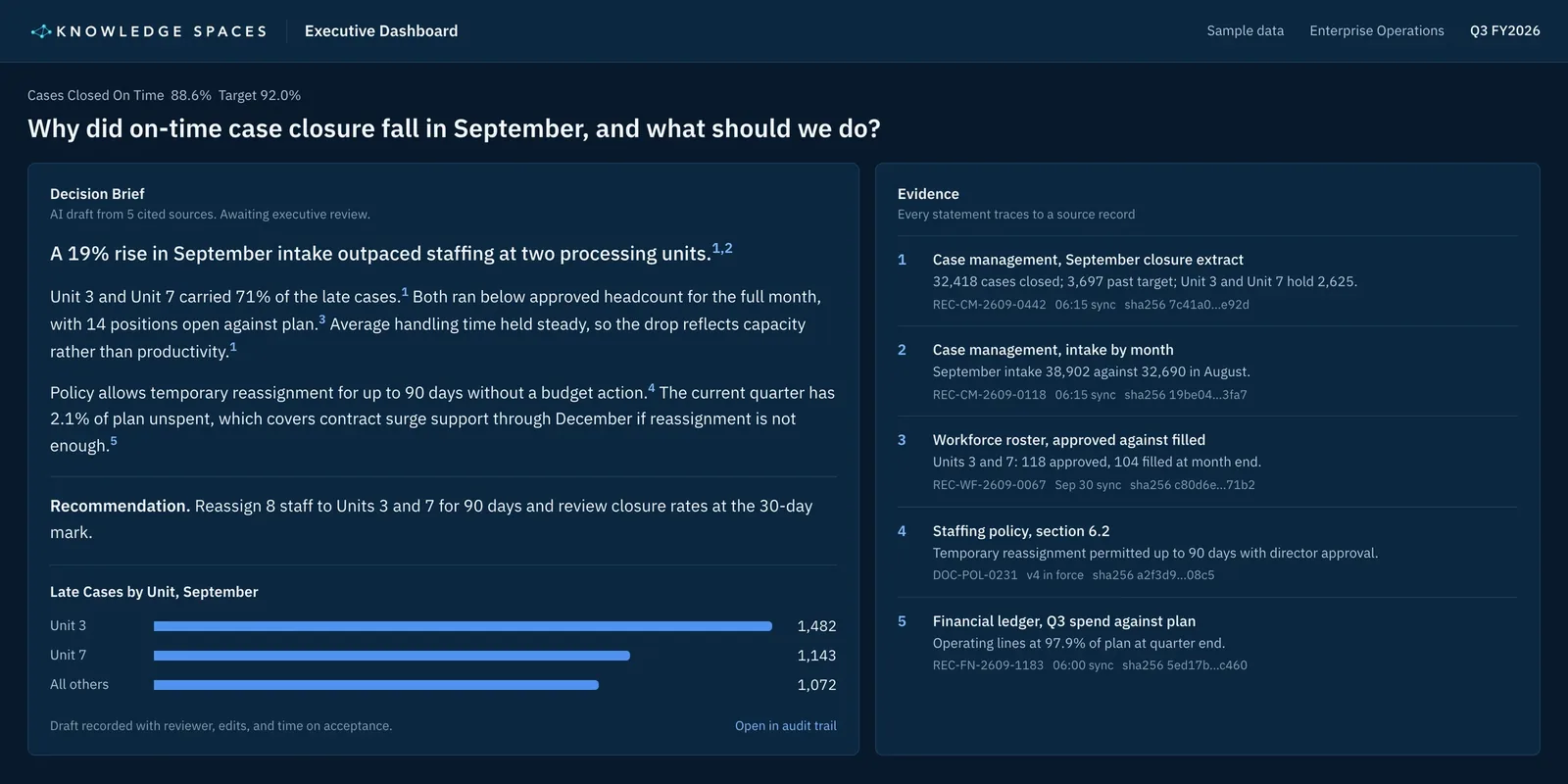
The same approach extends to complaint triage, AML case narratives drafted for an investigator's review, credit memos drafted for an underwriter, claims file review, research summaries, and client reporting. Credit, coverage, and investment decisions stay with your staff, and client-facing assistants follow once your risk team has reviewed the evidence from that first work.
Financial Supervision and Public Finance
Federal and state regulators and supervisors, and budget, revenue, and audit offices, review large volumes of regulatory reports, filings, issuances, and transaction records, and each finding must be traceable to its source. Each office's applications run on Knowledge Spaces, on its own documents and data, in an organization of its own, hosted where the office decides and open only to the people it authorizes.
- Supervisory Review
- Off-site indicators of asset quality, concentrations, and insider lending drawn from Call Reports and other regulatory reports, and issuer filings checked against disclosure rules, each finding linked to its source.
- Regulatory Issuance Assistants
- Cited answers from rules, bulletins, supervisory letters, and guidance, with the governing passage quoted.
- Suspicious Activity Report Triage
- Reports prioritized by risk, with cited evidence for analysts and a case record investigators and counsel can rely on.
- Budget Execution
- Spending tracked against plan and apportionment, cash forecasting from daily receipts and payments, and reconciliation controls that prove the ledgers agree.
- Revenue Administration
- Risk-based case selection with the reasons for each score shown, return and filing analytics, and assistants for examiners and revenue officers that answer from tax law, regulations, and rulings with the source cited.
- Procurement and Audit
- Risk analytics on solicitations and contract awards, and cited review of transactions and supporting documents for audit teams and inspectors general, with every finding traceable to the record behind it.
Our senior practitioners bring experience in federal financial management program leadership, financial systems architecture for budgeting and consolidation platforms, AI strategy and governance, and federal business and financial analysis.
Work begins with the decisions that would benefit most from faster access to the documents and data behind them. Measures are agreed with the sponsor at the start, such as audit cycle time, triage backlog cleared, or time from regulatory report to supervisory finding.
Cited Answers Over Regulatory Issuances
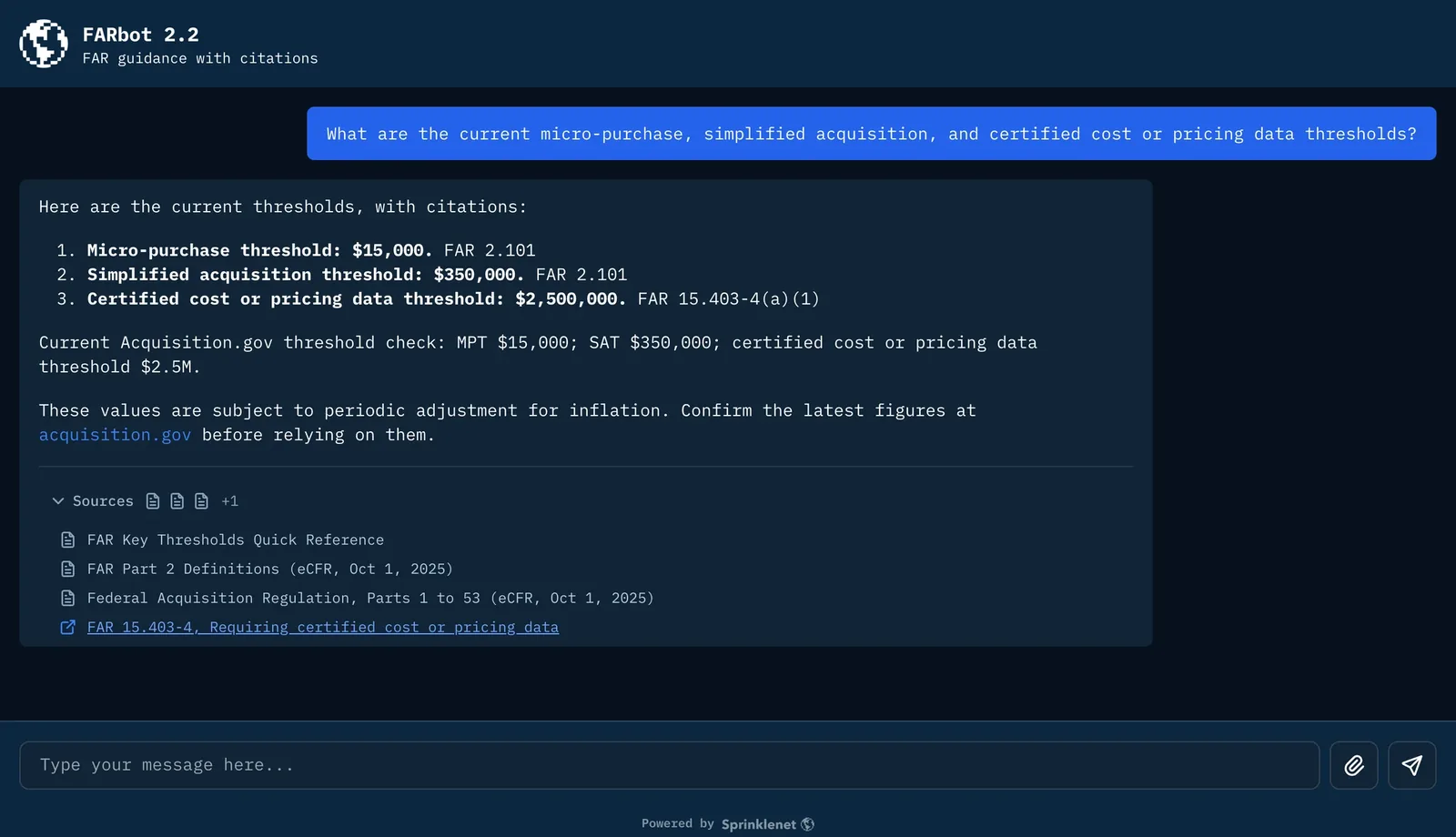
Regulators amend, extend, and rescind their own issuances, and an answer is only useful if it reflects the guidance now in force. A Knowledge Spaces assistant answers from the issuances loaded for it, and each answer is built to meet three tests. FARbot, shown here, gives cited answers from the Federal Acquisition Regulation.
- CitedEach answer is built to quote the governing text and name the issuance and paragraph it came from.
- In ForceWhen a later issuance has replaced an earlier one, the answer is built to say which guidance is in force and quote the passage that replaced the earlier one.
- DeclinedWhen the loaded documents do not contain the answer, the assistant is built to say so and name the documents it searched.
Controls for Examiners and Internal Audit
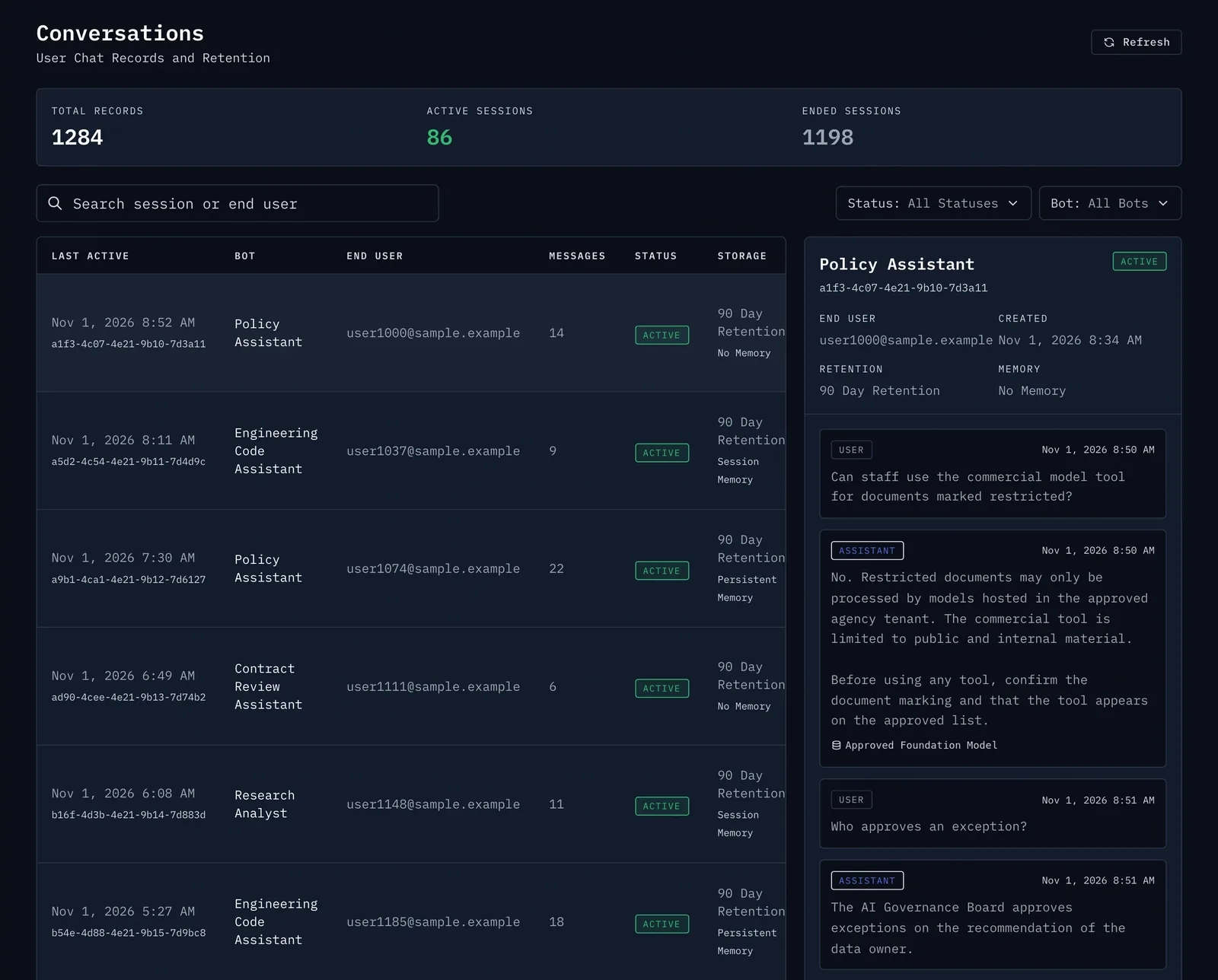
Permissions apply at retrieval time, prompts and outputs are logged to an audit trail, and provider and data retention terms are reviewed before a model is approved. Each answer records the provider and model version that produced it, and front-line staff can flag a recommendation that appears incorrect or inconsistent. Human review stays in the workflow under your institution's existing policies, and each application enters your model inventory, in Merlin or your existing tool, with its purpose, owner, risk rating, evaluation results, and change history. Your validators can rerun its evaluation set, and the same record supports an examination request. Your third-party risk team receives our security white paper, architecture and data-flow documentation, and the model providers and subprocessors for your deployment before any data connects.
- Deployment
- As a managed service, in your own AWS, Azure, or Google Cloud account, including government regions, or on-premises infrastructure, including air-gapped networks, scoped for each engagement.
- Identity
- Multi-factor authentication, with SAML 2.0 SSO and PIV, CAC, and PKI support for enterprise and federal deployments.
- Model Policy
- Each deployment runs from a model list your institution approves. An application can be limited to models hosted inside your authorization boundary, and a provider you bar stays off that deployment.
Knowledge Spaces VRMS for Third-Party Risk
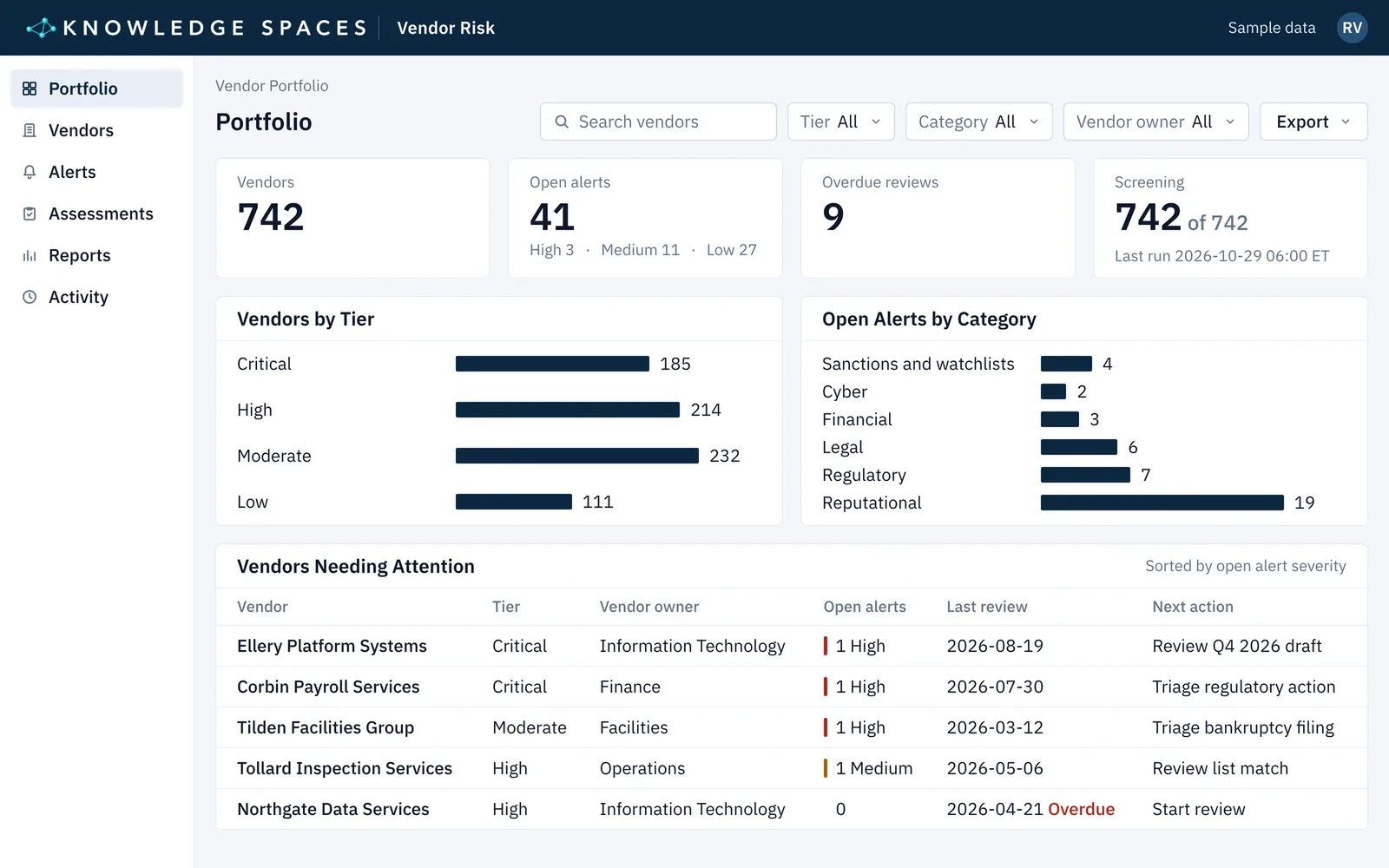
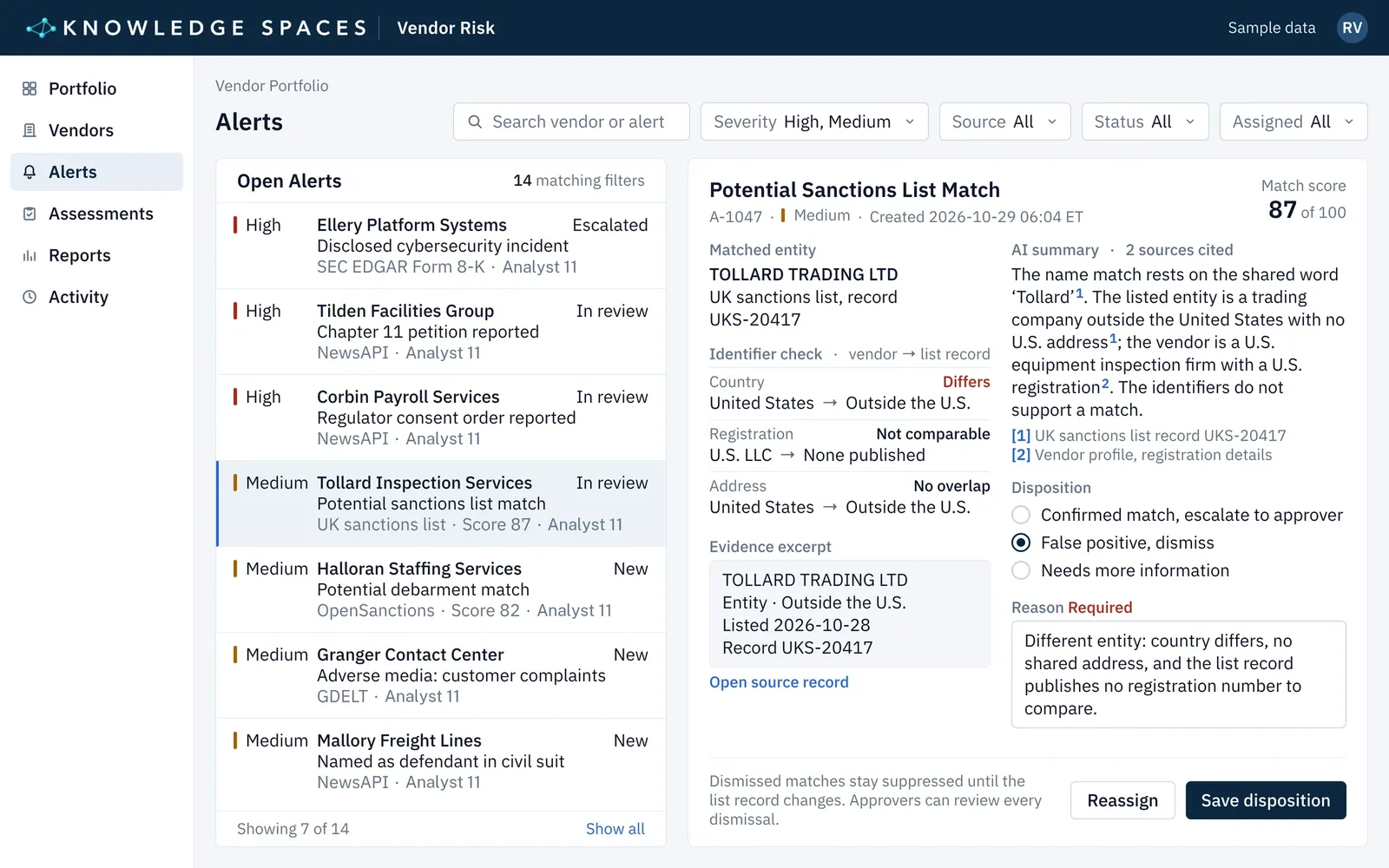
Knowledge Spaces VRMS runs third-party due diligence, risk scoring, and continuous monitoring on one auditable record. Vendors are screened against sanctions lists and adverse media, and each assessment is drafted with numbered sources for a reviewer to accept, change, or reject.

Financial Systems Integration
Interfaces between financial management, budgeting, and reporting systems, data migration from legacy sources, and reconciliation that proves the migrated data complete. Pipelines, data models, and reporting for program and financial data.
Healthcare
Claims, enrollment, and quality data are where the value sits, and all of it is PHI. Analytics run against the full data inside the governed boundary, so you keep the linked detail that de-identification removes. What reaches the model is a retrieved excerpt, with identifiers masked or tokenized where the deployment requires it, under no-retention, no-training terms. Connectors reach electronic health record and claims systems through HL7 FHIR APIs or your integration engine, each on your authorization, and clinical decisions stay with your clinicians. Our security white paper maps the controls to HIPAA obligations.
Other Industries
- Legal and Investigative Work
- Cited search across case files, contracts, and records, with permissions that follow each matter and an audit trail of who asked what.
- Public Benefits and Claims
- Case triage and document review, with a person deciding each consequential outcome.
- Professional Services
- Your methodology, under your brand, delivered to many clients in isolated organizations.
- Private Capital
- Portfolio-wide insight while maintaining strict boundaries between companies, teams, and external audiences.
- Real Estate
- Every agent gets a compliant client-facing assistant while the broker keeps guardrails and brand standards.
- Consumer Brands
- A brand combines internal performance data with curated partner insights, and each party's data stays under its own controls.
Related Reading

Bring One Regulated Workflow
Name the workflow and the regulations it falls under. We will run it on synthetic data and give your risk team the evidence file from that run: the inventory entry, evaluation scores, change log, access log, and approvals. We then scope the pilot around the controls your regulators and auditors will ask about.