Retrieval-augmented generation, commonly known as RAG, has emerged as one of the most important architectural patterns in enterprise AI. Unlike traditional chatbots that generate responses from the patterns they learned during training, RAG systems anchor their answers in actual documents and data. This makes them significantly more reliable, more auditable, and more useful for high-stakes business and government applications.
At Sprinklenet, RAG is the foundation of everything we build. Our flagship platform, Knowledge Spaces, is built entirely on retrieval-augmented generation principles. Understanding what RAG is, why it matters, and how it compares to other approaches is essential for any organization evaluating AI knowledge management solutions.
How RAG Works
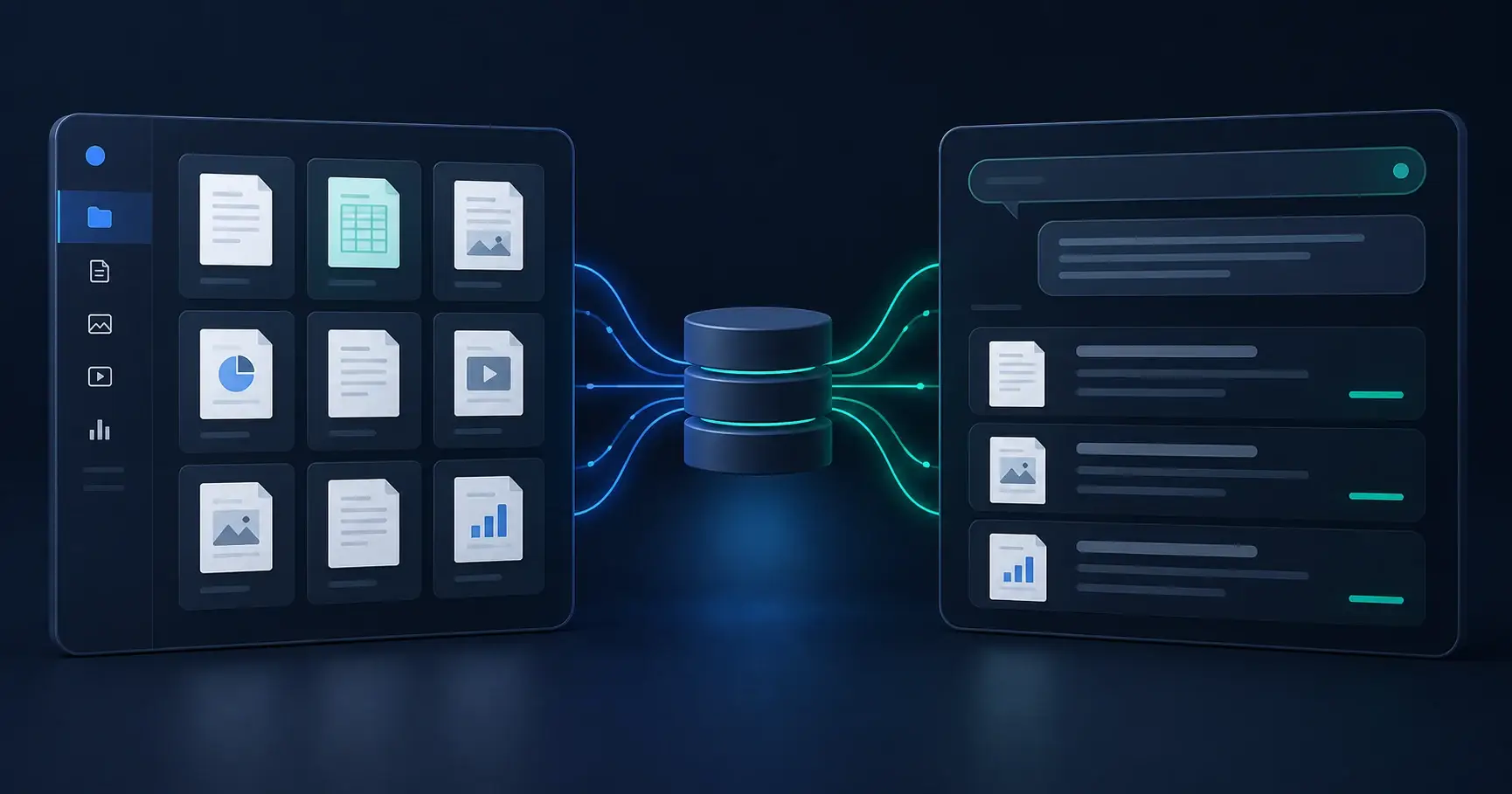
The RAG process involves three stages: indexing, retrieval, and generation. During the indexing phase, your documents are processed, broken into meaningful segments, and converted into mathematical representations called embeddings. These embeddings capture the semantic meaning of each passage, not just the words it contains, but what those words actually mean in context.
When a user asks a question, the retrieval phase kicks in. The question is converted into the same type of embedding, and the system searches for document passages that are semantically similar to the query. This is fundamentally different from keyword search, a RAG system can match a question about “procurement officer responsibilities” with a passage about “duties of the contracting official” even though the words are completely different.
Finally, the generation phase takes the retrieved passages and uses a large language model to compose a coherent, natural-language answer. Critically, the model is instructed to base its answer only on the retrieved evidence, not on its general training knowledge. This grounding mechanism is what makes RAG systems trustworthy, every claim in the answer can be traced back to a specific source document.
Why RAG Beats Fine-Tuning for Enterprise Knowledge
Organizations sometimes consider fine-tuning a language model on their proprietary data as an alternative to RAG. While fine-tuning has its uses, it has significant drawbacks for knowledge management applications. Fine-tuned models absorb information into their weights, making it impossible to trace answers back to specific sources. They also struggle with knowledge updates, every time your document library changes, you’d need to retrain the model. And they can confidently generate plausible-sounding but entirely fabricated answers when they encounter questions outside their training data.
RAG avoids all of these problems. Source attribution is built into the architecture. Knowledge updates happen instantly when new documents are indexed. And when the system doesn’t have relevant information, it can transparently indicate as much rather than inventing an answer. For regulated industries, government agencies, and any organization where accuracy and accountability matter, RAG is the clear choice.
RAG in Government: A Natural Fit
Government agencies are particularly well-suited for RAG-based solutions. They manage enormous document repositories, regulations, policies, procedures, technical manuals, historical records, legal opinions, that are often poorly organized and difficult to search. The consequences of incorrect information can be severe, making the source-attribution capabilities of RAG essential rather than nice-to-have.
Sprinklenet’s FARbot demonstrates the power of RAG in government. Built on the Knowledge Spaces platform, FARbot provides contracting professionals with instant, cited answers to questions about the Federal Acquisition Regulation. A question like “What are the small business subcontracting requirements for contracts over $750,000?” produces a comprehensive answer with specific citations to FAR parts, subparts, and clauses, enabling contracting officers to verify the answer and maintain the audit trail their work requires.
Advanced RAG Techniques
Not all RAG implementations are created equal. Basic RAG systems use simple vector similarity search, which works well for straightforward questions but struggles with complex queries that require synthesizing information from multiple documents. Knowledge Spaces employs several advanced techniques that significantly improve retrieval quality.
Hybrid search combines vector similarity with traditional keyword matching, ensuring that specific terms, acronyms, and identifiers aren’t lost in the semantic embedding process. Query decomposition breaks complex questions into sub-queries that can be answered independently and then synthesized. Re-ranking models evaluate the initial retrieval results and reorder them based on deeper relevance analysis. And contextual chunking ensures that document segments maintain their meaning even when separated from the surrounding content.
These techniques, combined with careful prompt engineering and output validation, are what separate enterprise-grade RAG systems like Knowledge Spaces from basic implementations that may produce inconsistent or unreliable results.
Evaluating RAG Solutions
When evaluating RAG-based knowledge management platforms, organizations should focus on several key criteria: retrieval accuracy (does the system find the right information?), answer faithfulness (does the generated answer accurately reflect the source material?), source transparency (can users verify where information came from?), handling of negative cases (what happens when the answer isn’t in the documents?), and scalability (does performance hold up as the document library grows?).
Knowledge Spaces excels across all of these dimensions, which is why it’s trusted by organizations managing sensitive government and enterprise information. To see how RAG-powered knowledge management could transform your organization’s information access, explore our Knowledge Spaces white paper or schedule a demo with the Sprinklenet team.