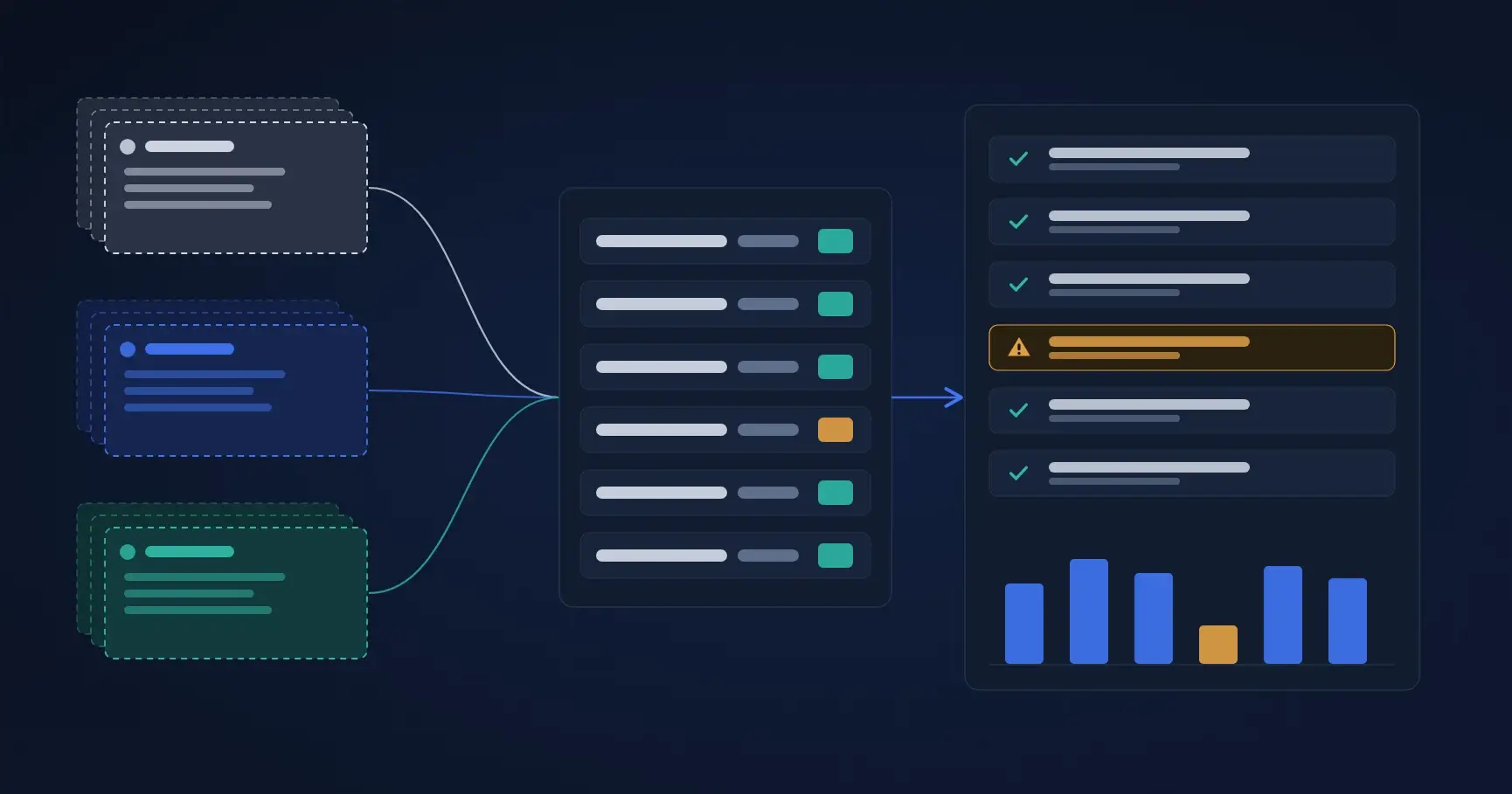

The organizations scaling AI most successfully share a common trait: they treat governance not as a compliance burden but as the foundation that makes everything else possible. Governance is what gives leadership the confidence to expand AI usage, what gives users the assurance that the system is trustworthy, and what gives auditors the evidence that the organization is operating responsibly.
Building governance into the foundation from day one is dramatically easier than retrofitting it later. The organizations that understand this early are the ones that scale AI with confidence rather than trepidation.
What follows is a practical framework drawn from Sprinklenet’s work advising enterprise and government clients on AI governance. These are the systems and controls that consistently matter when AI is making decisions that affect real people and real operations.
The Four Pillars of Production AI Governance
Pillar 1: Comprehensive Audit Logging
If there is one governance control that matters above all others, it is comprehensive audit logging. Not surface-level API call logging but full-chain audit logging that captures what happened, why it happened, and who was involved.
At minimum, an effective audit system captures:
- User identity. Who initiated the interaction, authenticated through the organization’s identity provider, not a generic API key.
- Model selection. Which specific model (including version) generated the response.
- Input context. The full prompt, including any retrieved documents or system instructions.
- Output content. The complete generated response, before and after any post-processing.
- Retrieval evidence. Which source documents were retrieved, their relevance scores, and which passages were used.
- Guardrail actions. Any content that was flagged, modified, or blocked by safety filters.
- Timestamps and session context. Enough to reconstruct the full conversation flow.
In Knowledge Spaces, the platform logs 64+ distinct event types. That number grew organically from real compliance requirements across government and enterprise deployments. Every time a client needed to answer “what exactly happened when…” the team ensured the audit system could provide a complete answer. After enough of those conversations, comprehensive coverage becomes the natural baseline.
The key insight: audit logs serve three purposes simultaneously. They satisfy compliance requirements, they provide the primary debugging and quality improvement data source, and they offer legal protection. Building them to serve all three purposes from the start creates compounding value.
Pillar 2: Granular Access Control
Effective access control for AI systems goes well beyond basic role assignment. Production AI governance requires multi-dimensional controls that reflect how organizations actually manage information.
Organizational boundaries. In multi-tenant environments, data isolation between organizations must be absolute, not just at the application layer, but at the database layer, the vector store layer, and the model context layer. A user in Organization A should never receive a response informed by Organization B’s documents.
Role hierarchies. A proven model uses four tiers: platform administrators, organization administrators, managers, and end users. Each tier has different capabilities around data management, user provisioning, configuration, and analytics access. The distinction matters because governance involves controlling not just what users can ask, but who can change the rules.
Content-level controls. Some documents should only be retrievable by certain users. Some AI capabilities should only be available to certain roles. Some topics should be entirely outside scope for certain deployments. These controls need to be configurable without writing code, because the people making governance decisions are often not the same people who build the platform.
Authentication integration. For government work, this means SAML 2.0 SSO and CAC/PKI support. For commercial clients, it means OAuth integration with their identity provider. AI access must flow through existing identity infrastructure. Shadow AI, where employees use AI tools outside the governance perimeter, is one of the largest and most underappreciated risks organizations face today. Strong authentication integration is the first step in addressing it.
Pillar 3: Model Monitoring and Quality Gates
Deploying an AI model without ongoing monitoring leaves the organization without visibility into whether the system is performing as expected. Effective monitoring covers several dimensions.
Response quality monitoring. Track hallucination rates, citation accuracy, and user satisfaction over time, not just at launch, but continuously. Model behavior shifts with provider updates, data changes, and evolving user patterns.
Guardrail effectiveness. Measure how often safety filters trigger and what they catch. Are they blocking legitimate queries that frustrate users, or missing problematic ones that create risk? Continuous tuning keeps the balance between safety and usability.
Cost and performance tracking. Governance includes financial governance. Tracking token usage, model costs, and response latency per user, per department, and per use case provides the visibility needed to optimize spending and identify unusual patterns early.
Evaluation gates. Before any AI system moves from pilot to production, establishing pass/fail criteria creates a clear quality standard. Sprinklenet uses configurable evaluation gates that test accuracy, safety, and performance against defined benchmarks. If the system does not pass, it does not deploy. Formal evaluation before production deployment is one of the most valuable governance practices an organization can adopt.
Pillar 4: Compliance Mapping
Every industry has regulatory requirements that touch AI. The practical challenge is mapping abstract regulations to concrete technical controls.
For government (DoW, IC, federal civilian): NIST AI RMF, NIST 800-53 controls, FedRAMP requirements, and agency-specific AI policies. These are conditions of operating in the federal space.
For financial services: Model risk management (SR 11-7 equivalent), fair lending compliance, and explainability requirements.
For healthcare: HIPAA considerations when AI processes PHI, and FDA guidance on AI/ML-based medical devices.
For all organizations: The EU AI Act is taking effect, and even U.S.-based companies serving European customers or partners will benefit from alignment with its requirements.
The practical approach is to build a controls matrix: regulatory requirements in rows, technical controls in columns, and coverage mapped between them. Gaps become the remediation roadmap. This is also the document that auditors will expect to see, so building it early and maintaining it continuously saves significant time during formal assessments.
Common Governance Gaps and How to Close Them
Governing the model but not the data. AI is only as trustworthy as the data it retrieves. If document management lacks version control, access restrictions, and quality controls, the governance framework has a gap at its foundation. Extending governance to the data layer, through metadata management, ingestion controls, and document lifecycle policies, closes this gap.
Point-in-time assessment rather than continuous monitoring. AI governance is an ongoing operational discipline, not a one-time checklist. Models drift. Data changes. Users find creative ways to test boundaries. The most effective governance programs build monitoring and review cycles into regular operations.
Policy without technical enforcement. An “Acceptable AI Use Policy” is an important starting point. But policy reaches its full potential when paired with technical controls that implement it automatically. If the policy says “do not input PII into AI systems,” the platform should detect and handle PII programmatically. This is why Sprinklenet built PII detection, prompt injection prevention, and content moderation directly into the Knowledge Spaces guardrail engine, technical enforcement turns policy into practice.
Incomplete vendor governance. An organization’s governance framework should extend to its AI vendors. Which models power the vendor’s platform? How do they handle client data? What happens during a provider outage? Understanding the vendor’s own governance posture ensures there are no gaps that the organization cannot address internally.
Getting Started: A 30-Day Foundation
For organizations starting a governance program, a focused four-week plan builds a strong foundation.
Week 1: Inventory all AI usage across the organization. Every tool, every API, every application. Comprehensive visibility is the prerequisite for effective governance.
Week 2: Define the organization’s AI risk tolerance. What categories of AI use are encouraged, what requires additional controls, and what is outside acceptable bounds? Secure executive alignment on these boundaries.
Week 3: Evaluate current platforms against the four pillars above. Where are the strengths? Where are the gaps? Which gaps represent the most significant risk?
Week 4: Build the remediation roadmap. Prioritize by risk and impact. Identify quick wins that build momentum alongside the longer-term architectural investments.
For organizations using tools like FARbot for regulatory guidance, governance is partially built into the product, every response includes cited sources, retrieval logs track what information informed each answer, and usage limits are built in. But even with well-governed tools, the organizational framework around them is what creates comprehensive coverage.
Governance as a Competitive Advantage
The organizations that build strong AI governance early gain a compounding advantage. They scale AI faster because leadership has the confidence to approve new use cases. They win government contracts because they can demonstrate the audit trails, access controls, and compliance documentation that agencies require. They retain talent because engineers and data scientists prefer working in environments where AI is deployed responsibly.
AI governance is not overhead. It is the infrastructure that enables an organization to use AI ambitiously while managing risk effectively. The investment in building it properly pays dividends at every stage of AI maturity.
Need a practical AI governance framework?
Sprinklenet helps agencies and enterprises implement governed AI with built-in guardrails, audit logging, and policy-adaptive architecture.