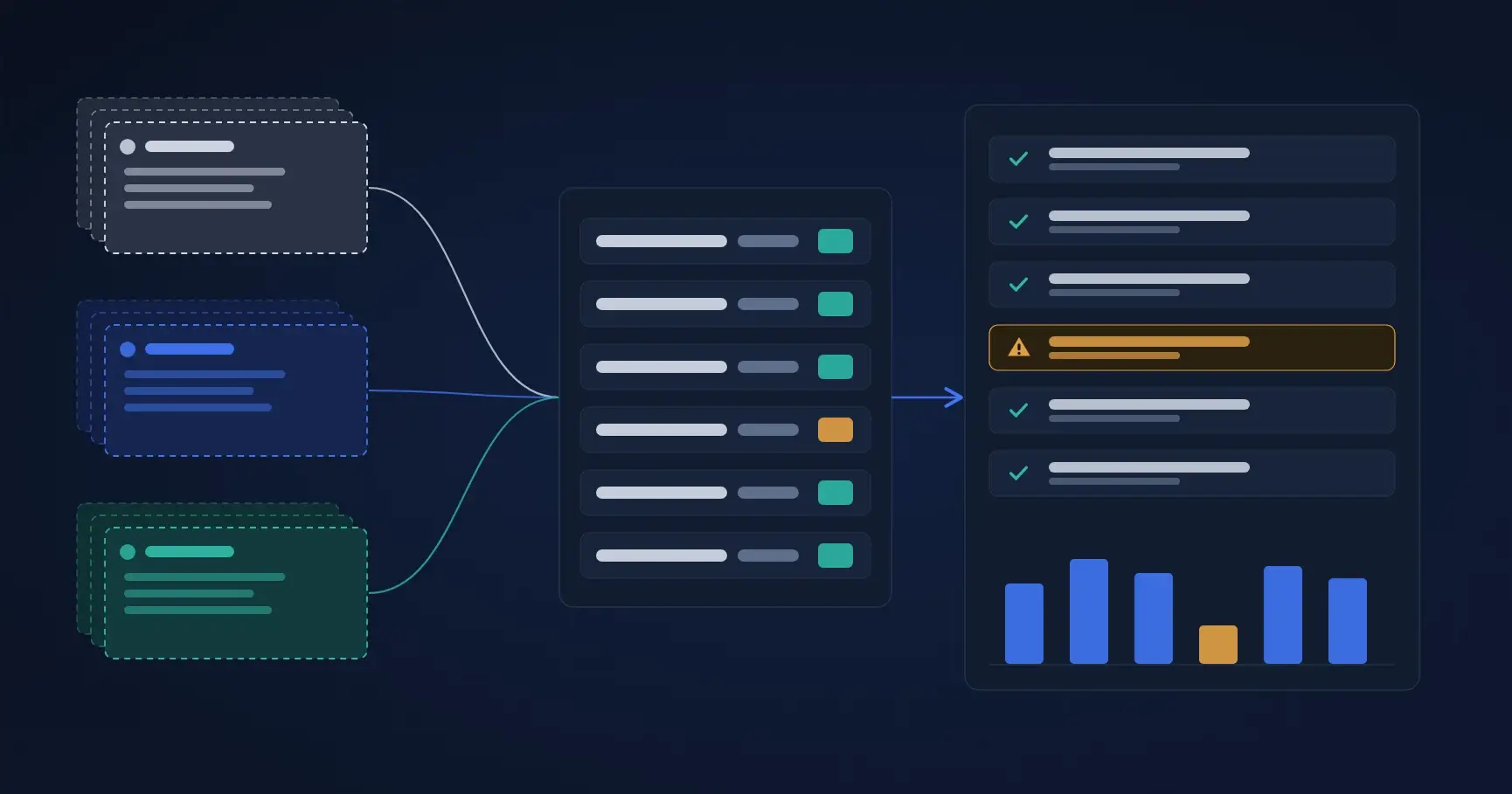

AI knowledge management is not a better intranet. It is a governed answer layer that helps people find, understand, and reuse the knowledge their organization already has. The goal is simple: make institutional memory available at the moment a team is making a decision, drafting a response, onboarding a new employee, resolving a support issue, or checking policy.
Most enterprises do not have a knowledge shortage. They have a retrieval, trust, and context problem. The same answer may be buried in a PDF, a past proposal, a ticket, a shared drive folder, a CRM note, and the head of a senior employee. Traditional search can find matching words. Modern AI knowledge management has to do more: respect permissions, retrieve the right evidence, explain where the answer came from, and help teams act on it.
The Real Knowledge Management Problem
Enterprise knowledge breaks down in predictable ways. Documents are stored by department instead of by business question. File names reflect a moment in time rather than the current decision process. Teams copy old language because they cannot tell which source is authoritative. New employees interrupt subject matter experts for answers that already exist. Experienced staff leave, and the rationale behind decisions leaves with them.
The cost is not just wasted search time. It shows up as slower proposals, inconsistent customer responses, duplicated engineering work, policy drift, avoidable compliance risk, and decisions made from partial context. The more regulated or distributed the organization becomes, the more expensive this problem gets.
What AI Changes
AI changes knowledge management because it can work with meaning instead of only metadata. A user can ask, “What security requirements did we use on similar agency work?” and the system can retrieve relevant passages even when the exact words in the question do not appear in the source material. That is the practical difference between keyword search and semantic retrieval.
The best systems do not stop at retrieval. They assemble an answer, cite the underlying sources, show uncertainty where the record is thin, and keep the user inside the permissions they already have. For enterprise teams, that combination matters more than a fluent chatbot. Fluency without governance is a demo. Cited answers with access control are the beginning of production.
2026 Field Note
The winning pattern is not to replace every repository. It is to make existing repositories usable through permissions-aware retrieval, citations, freshness checks, and workflow-aware AI.
The Production Architecture
A reliable AI knowledge management system usually has five layers. Each layer matters, and skipping one is where many pilots stall.
1. Connectors and Ingestion
The system needs controlled access to the places where knowledge already lives: document repositories, shared drives, CRM systems, ticketing tools, databases, wikis, email archives, and approved chat exports. The point is not to move everything into a new repository. The point is to create a governed index that can find the right material across systems.
2. Identity and Permissions
Access control has to be designed before the first broad rollout. A knowledge assistant should not reveal information just because it can retrieve it. It should inherit enterprise identity, respect source-system permissions, and apply additional role-based controls where the business requires them. This is especially important for federal, legal, healthcare, finance, HR, and other sensitive operating environments.
3. Retrieval and Ranking
Retrieval is more than converting documents into embeddings. Strong systems chunk content carefully, preserve document structure, combine semantic and keyword signals, rerank results, and understand which source should be treated as authoritative. A stale slide deck, a signed policy, and a recent project note should not carry the same weight.
4. Answer Generation With Evidence
The answer layer should synthesize across retrieved material while keeping the evidence visible. Users need to inspect source passages, open the original document when necessary, and understand whether the answer is based on a policy, a precedent, a draft, or an informal note. Citations are not decorative. They are how people decide whether to trust the system.
5. Audit and Improvement
Every serious deployment needs feedback loops. Failed questions should reveal missing content. Repeated questions should identify high-value knowledge domains. Low-confidence answers should trigger review. Audit logs should show who asked what, which sources were used, and where sensitive information appeared. Without this layer, the knowledge base degrades quietly.
Where Enterprise Teams See Value First
The strongest first use cases are narrow enough to govern and valuable enough that users feel the difference immediately. Good candidates include:
- Onboarding: help new employees understand processes, customers, systems, and decision history without constantly interrupting senior staff.
- Proposal and capture work: retrieve past performance language, technical approaches, compliance artifacts, and pricing rationale faster while keeping sources traceable.
- Policy and compliance lookup: answer operational questions from approved policy, procedure, FAR/DFARS, contract, or internal control documents.
- Engineering and product support: connect design docs, release notes, support tickets, architecture decisions, and known issues into one answerable knowledge layer.
- Customer and internal service desks: reduce escalations by giving support teams cited answers from approved knowledge sources.
The common thread is repeatable questions. If a team asks the same class of question every week, and the answer requires searching across multiple systems, that workflow is a candidate for AI knowledge management.
What Separates a Good Pilot From a Fragile Demo
A fragile demo answers a few handpicked questions. A good pilot proves that the system can handle real users, imperfect documents, security boundaries, and operational feedback. The difference is mostly discipline.
- Start with a defined knowledge domain. A focused corpus beats a vague enterprise-wide crawl.
- Name the authoritative sources. Decide which documents win when sources disagree.
- Test with real questions. Build an evaluation set from actual user tasks, not vendor-friendly prompts.
- Measure outcomes. Track time-to-answer, escalation rate, answer acceptance, source coverage, and content gaps.
- Assign ownership. Someone has to maintain the knowledge domain, review failures, and retire stale material.
This is where many AI initiatives become more operational than experimental. The model is only one part of the system. The lasting value comes from the data pipeline, governance model, evaluation process, and workflow fit.
A Practical Implementation Path
The safest path is to start with one high-value team and one clear knowledge domain. Inventory the source systems. Identify the most common questions. Define who is allowed to see what. Build the retrieval layer. Test against real tasks. Put the system in front of a small group of users. Then use feedback to improve the corpus, prompts, retrieval rules, and answer format.
Once the first domain works, expansion becomes easier. The team has a pattern for connectors, permissions, evaluation, and adoption. New domains can reuse that pattern instead of starting from scratch. This is how AI knowledge management becomes an enterprise capability rather than a one-off chatbot.
Related Reading
For the technical foundation, see Sprinklenet’s guide to RAG pipeline architecture. For business case planning, see measuring the ROI of AI knowledge management.
How Sprinklenet Approaches AI Knowledge Management
Sprinklenet builds governed AI knowledge systems for enterprise and federal teams that need more than a generic chatbot. Our Knowledge Spaces platform connects multiple data sources, applies role-based access control, supports cited retrieval, and gives teams a repeatable path from focused pilot to production deployment.
The important question is not whether an organization can put AI in front of a document library. It can. The important question is whether the resulting system improves decisions, protects sensitive information, earns user trust, and keeps improving as the organization changes.
Jamie Thompson is founder and CEO of Sprinklenet, focused on governed AI implementation, systems integration, and Knowledge Spaces.
His work centers on moving AI from pilot activity into production with clearer retrieval, workflow, evaluation, and audit controls. LinkedIn profile.