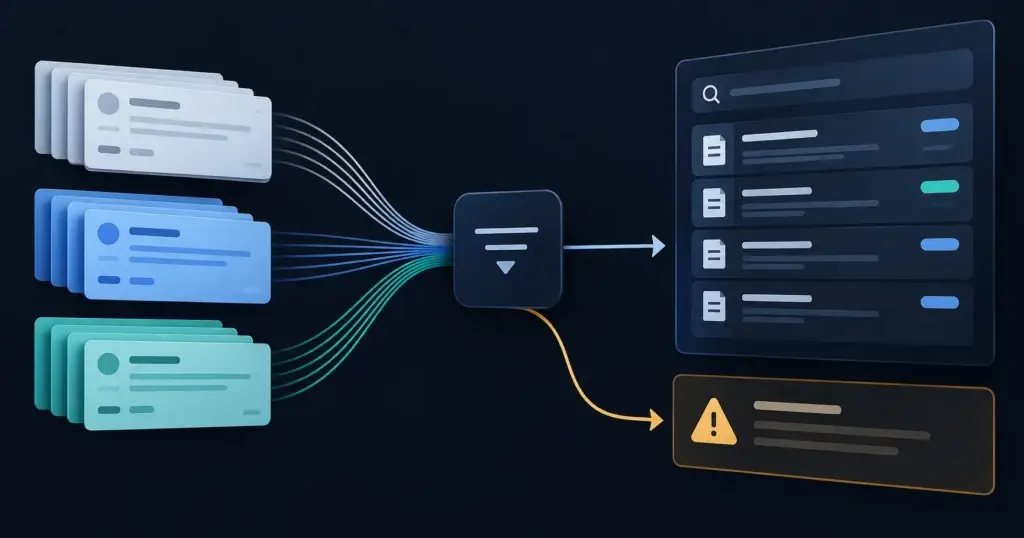
How to Design Human Review for Agentic Automation
For each action, define who may request it, what the reviewer sees, and what the system does after approval or rejection.
 Knowledge Spaces
Applications
Governance
Delivery
Advisory
Industries
Government and Teaming
Company
Contact
Contact
Scope a Six-Week Pilot
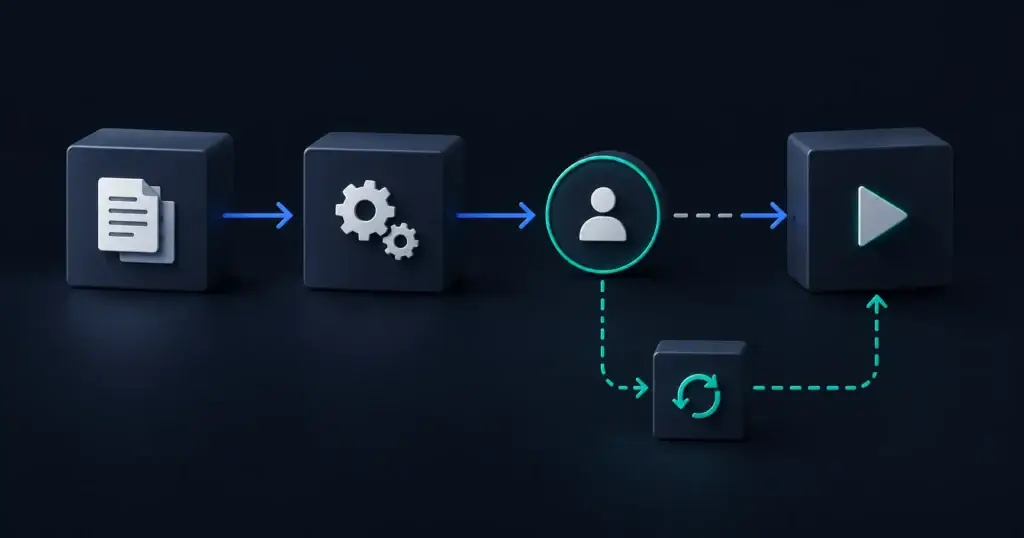
Describe one workflow as allowed steps, approval points, and recovery paths. Use narrow permissions for each action and record the approved input. Test partial completion and retries so a failed step does not silently create duplicate or inconsistent records.
Write the valid steps from intake to completed work, including required evidence and permissions. Separate a proposed action from the action that changes the system of record.
Show the reviewer the specific record and proposed change. Bind approval to those inputs and invalidate it if the requested operation changes.
Specify what happens after a timeout, rejected approval, failed tool, or duplicate request. Use operation identifiers or equivalent application logic to prevent unintended duplicate changes.
A timeout does not always reveal whether an external action occurred. In a hypothetical workflow, the destination system might accept a record update while the assistant loses the confirmation. Blindly repeating the operation could create an unintended second change. The application needs a way to check the destination’s recorded state or recognize the original operation before retrying. Where that cannot be established reliably, route the case for investigation. A visible unresolved status is more useful than an apparent success that hides uncertainty about the system of record.
Example: If a ticket is created but the confirmation response is lost, a retry should find the original result rather than create a second ticket.
Give unresolved cases an owner, clear status, and recovery procedure. Measure successful completed work, rework, and exceptions instead of celebrating tool-call volume.
Discuss the implementation scope with Sprinklenet. A useful starting point: an end-to-end workflow and failure-recovery design for one automation.
The recommendations above are Sprinklenet’s practical guidance. Technical context: OWASP Excessive Agency, OWASP Prompt Injection.

For each action, define who may request it, what the reviewer sees, and what the system does after approval or rejection.
Ask the supplier to demonstrate one allowed request, one denied request, a revoked permission, and a failed connector.
Choose one recurring ticket type with a maintained knowledge source and a clear owner.
Most weeks I send one short read on enterprise AI: what’s working in real deployments, what’s not, and what I’d do in your seat.
Jamie Thompson, Founder and CEO