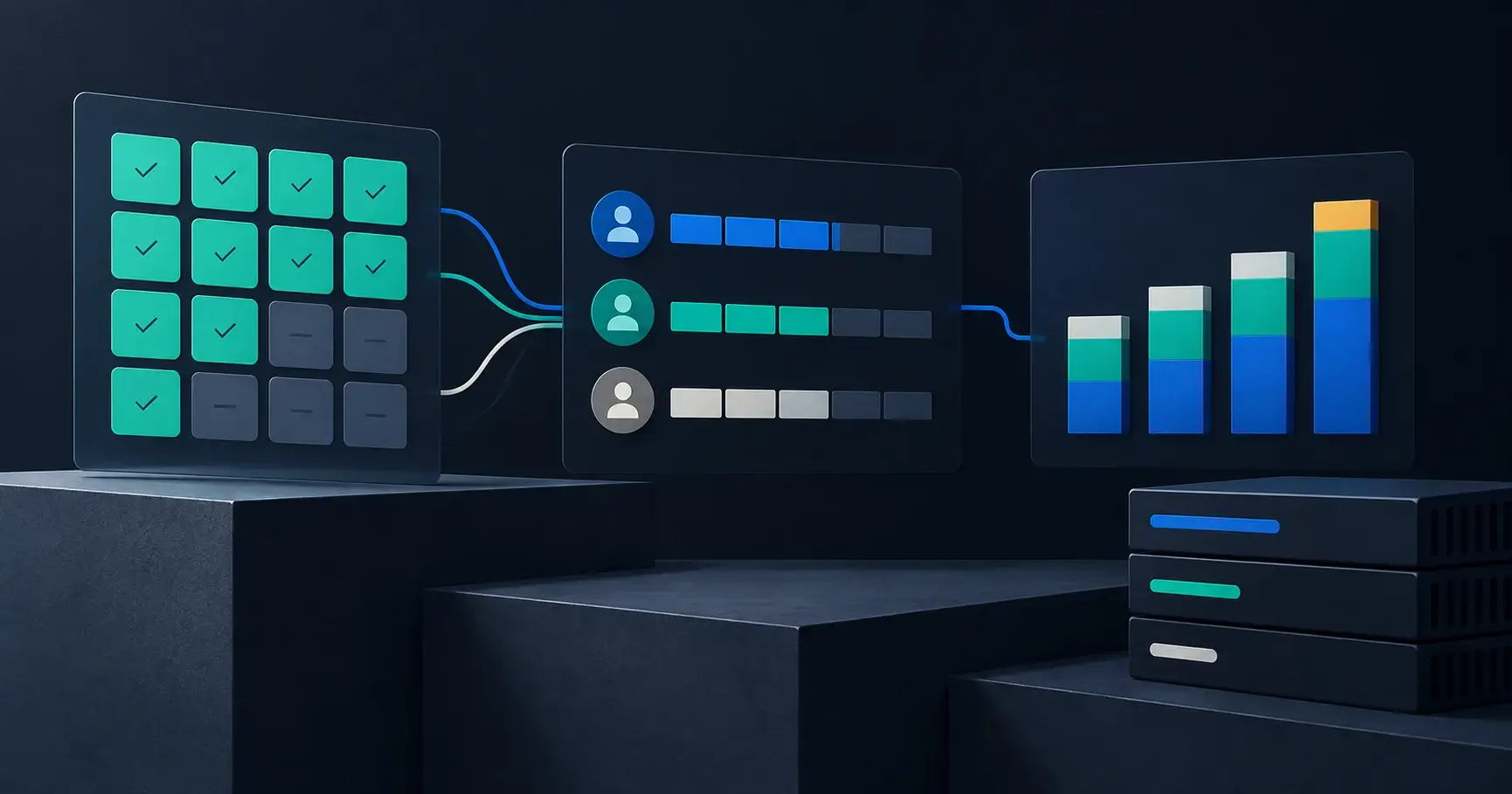
Most of the fine-tuning requests that reach us are retrieval problems wearing a training budget. A team notices the model does not know their products, policies, or acronyms, and concludes the fix is to train those facts into the weights. The instinct is reasonable and usually wrong, because fine-tuning changes how a model behaves, not what it reliably knows.
The distinction sounds academic until you price it. A fact in a retrieval layer gets corrected by editing a document. A fact baked into the weights gets corrected by another training run, and until that ships, every user receives the stale answer with full confidence.
Executive Takeaway
- Put facts that change in retrieval. Reserve fine-tuning for behavior that repeats: output structure, tone, classification, domain phrasing.
- A fine-tuned model cannot cite its sources, cannot enforce per-user permissions, and cannot forget. If any of those three matter, the knowledge belongs in a retrieval layer.
- Do not approve a training budget until an evaluation set shows the baseline failing and names the number that has to move.
Diagnose the Failure Before Choosing the Tool
Fine-tuning versus retrieval is not a technology preference. It is a diagnosis. When an AI system disappoints, the failure is one of four things: the model lacks facts, it has the facts but presents them badly, it performs fine but the workflow around it is broken, or nobody defined what a good answer looks like.
Missing or wrong facts point to retrieval. Correct facts in the wrong format or tone point first to prompting, then to fine-tuning. A system that answers well yet still fails its users points to workflow design: routing, escalation, what happens when confidence is low. Teams that skip the diagnosis buy the most expensive intervention on the menu, training, to fix the cheapest problem on the list, usually a prompt.
What Fine-Tuning Is Actually Good For
Fine-tuning earns its cost in a narrow set of situations, and they share one property: the target is a stable, repeatable behavior rather than a moving body of facts. Emitting a strict output schema on every call. Holding a specific voice across thousands of generations. Classifying documents against a label set that has not changed in years. In each case the behavior can be demonstrated with examples that will still be correct next quarter.
The other legitimate case is economics. When a smaller model plus a training run can match what a large model does with a three-page prompt, latency and per-call cost both drop, which matters at volume. The trade only pays off if the evaluation set existed first; otherwise nobody can prove the cheap model matched the original.
Why Documents Do Not Belong in the Weights
Training a model on a document library does not make it a reliable witness to that library. The model learns to sound like your documents while still inventing specifics, because next-token training teaches style, not lookup. That is worse than a generic chatbot getting it wrong, since the fabrication now arrives in your company’s voice.
Weights also fail the governance tests that enterprise and government-grade environments impose. A fine-tuned model gives every user the same answer regardless of what each is cleared to see; a retrieval layer can check permissions on every query. Weights cannot produce a citation; retrieval can point to the paragraph. And when a contract or a deletion request says content must go, a document comes out of an index in minutes. Getting it out of a trained model means retraining.
This is why Knowledge Spaces is built retrieval-first. The platform keeps enterprise knowledge in a governed retrieval layer, with source-level permissions and citations on every answer, and treats the model as a swappable component. Facts stay current because they live where someone can edit them.
The Operating Cost Nobody Prices In
A fine-tuned model is not a feature. It is an artifact the organization now owns: it needs version control, a regression suite, and a plan for the day the provider deprecates the base model, forcing a retrain on someone else’s schedule. The data pipeline usually costs more than the training itself, because curating clean examples is slow, judgment-heavy work.
The calendar cost shows up hardest during delivery. In a six-week pilot-to-production window, a retrieval system absorbs feedback continuously because each fix is a content or configuration change. A fine-tuning loop consumes days per cycle and burns exactly the weeks you need for iterating with real users.
Failure Modes We See Most Often
- Fine-tuning to memorize documents, then discovering the model still invents specifics and cannot say where anything came from.
- Blaming the model and reaching for training when a better system prompt or a retrieval fix would have closed the gap in days.
- Shipping a custom model with no evaluation harness, so nobody can prove the tuning helped or catch the regressions it introduced.
All three share a root cause: a training run without a benchmark is not engineering, it is an expensive way to change the model’s mood.
Three Questions Before You Fund a Training Run
- Is the problem missing knowledge or wrong behavior? If subject-matter experts say the answers are factually wrong, that is knowledge, and it belongs in retrieval.
- How often does the source content change, and who pays for the retrain if the answer is monthly?
- What benchmark shows the baseline failing today, and what number has to move before the training run counts as a success?
In mature systems the honest answer is often both: retrieval owns the facts, a lightly tuned model owns the format. What separates that from a science project is the order of operations: prompting and retrieval first, evaluation always, training last and only with a number attached.
Where Sprinklenet Lands
Sprinklenet builds production AI systems designed for enterprise and government-grade requirements, and the fine-tune-or-retrieve question comes up in nearly every engagement. Our default is the unglamorous one: exhaust prompting and retrieval, stand up the evaluation harness early, and let the numbers, not the vendor pitch, decide whether training is justified.
Explore Knowledge Spaces, review our AI services, or contact Sprinklenet to pressure-test a fine-tuning plan before it becomes a budget line.