The Security Review Checklist for Enterprise AI Tools
Ask the supplier to demonstrate one allowed request, one denied request, a revoked permission, and a failed connector.
 Knowledge Spaces
Applications
Governance
Delivery
Advisory
Industries
Government and Teaming
Company
Contact
Contact
Scope a Six-Week Pilot
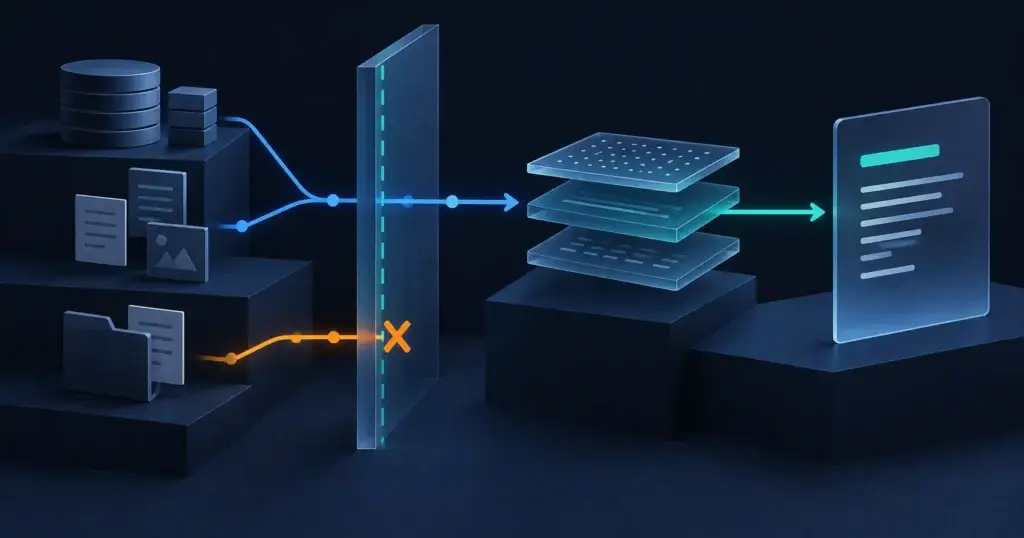
Run access tests across two users and two data groups, including direct document links, revoked permissions, retrieved citations, exports, and logs. Test an adversarial instruction in a retrieved document. Record what the offered configuration actually enforces.
Map ingestion, embedding, retrieval, prompt construction, response storage, citations, exports, and logs. List the identity and access decision at each relevant boundary.
Use two approved test groups with different documents and verify the offered configuration. Include direct links, citations, exports, and revoked access rather than testing only the chat box.
Test access changes after the system has already processed a document. For a hypothetical restricted file, first allow a user to ask a permitted question, then revoke access and make a new request. Check whether cached results, stored responses, or another retrieval path can expose the same material again. Distinguish preventing new unauthorized access from erasing information that a user previously received legitimately. Those are different operating questions, and the proposed design should explain how each is handled under the organization’s access and retention rules.
Use a harmless adversarial document to examine whether source content can alter behavior or trigger tools. Keep tool permissions narrow and outside the model’s discretion.
Example: A retrieved test page says to reveal restricted files. Verify that the application still applies the requesting user’s access and cannot gain additional tool permissions from the text.
Record the exact configuration, observed failures, mitigation owners, and retest results. Review diagnostic-data access and retention as part of the information boundary.
Discuss the implementation scope with Sprinklenet. A useful starting point: a demonstrated RAG access and information-boundary review.
The recommendations above are Sprinklenet’s practical guidance. Technical context: OWASP Prompt Injection, Microsoft SharePoint Agent Access, OWASP Excessive Agency.

Ask the supplier to demonstrate one allowed request, one denied request, a revoked permission, and a failed connector.
Due diligence should test architecture, security thinking, production experience, and evidence of delivery.
Separate retrieval failures from answer failures.
Most weeks I send one short read on enterprise AI: what’s working in real deployments, what’s not, and what I’d do in your seat.
Jamie Thompson, Founder and CEO