Vendor Due Diligence for AI Implementation Partners
Due diligence should test architecture, security thinking, production experience, and evidence of delivery.
 Knowledge Spaces
Applications
Governance
Delivery
Advisory
Industries
Government and Teaming
Company
Contact
Contact
Scope a Six-Week Pilot
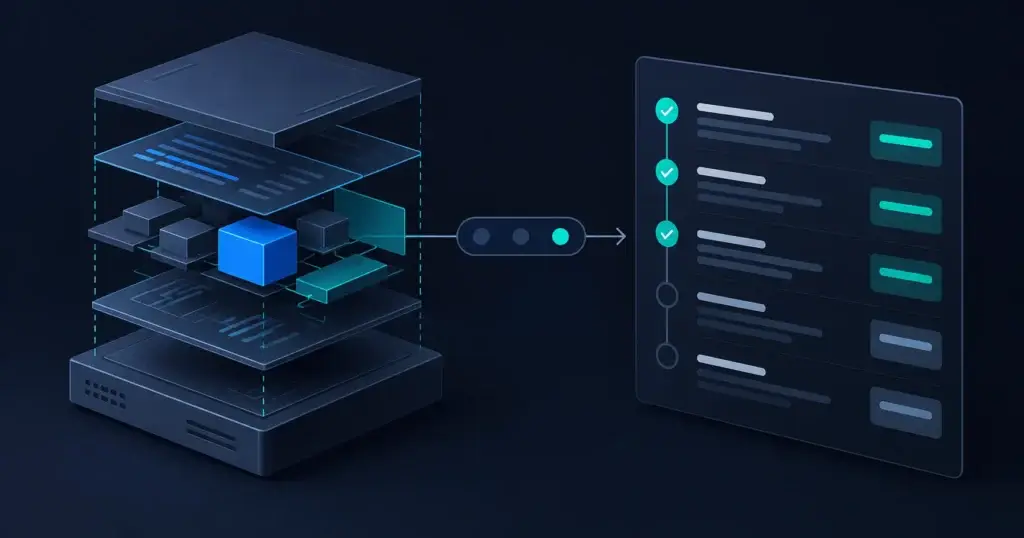
An operator should be able to identify the deployed configuration, reproduce a representative result, and respond to a failed import without relying on the original builder. Maintain source maps, configuration versions, evaluation records, and runbooks as part of each release.
Record the application release, models, prompts, retrieval settings, source collections, and environment dependencies. Keep the record tied to the actual release, not a prospective architecture diagram.
Maintain task examples, expected evidence, known limits, and evaluation results. Document changes to the test set and why a release was accepted.
Cover normal updates, failed ingestion, credential ownership, access changes, incident escalation, and recovery. Reference the approved secret store rather than copying credentials into general documentation.
Have someone other than the original builder follow a representative procedure. Record missing steps and repair them before calling the handoff complete.
A useful documentation test begins with a question an operator is likely to face: why did this answer change after the last release? The receiving team should be able to identify the relevant source and configuration changes, locate evaluation results, and find the person responsible for the decision. If those records exist only in a builder’s chat history, the documentation is incomplete even when a polished architecture diagram is available. Use the exercise to find missing operational context, then add only the information needed to answer the question reliably.
Example: A receiving operator detects a failed import, checks the documented evidence, restores normal processing, and verifies a known query without asking the builder for an undocumented command.
Discuss the implementation scope with Sprinklenet. A useful starting point: an operational documentation and handoff-readiness review.
The recommendations above are Sprinklenet’s practical guidance. Technical context: NIST Secure Software Development Framework.

Due diligence should test architecture, security thinking, production experience, and evidence of delivery.
Before building the index, select a representative document set and test extraction, source identifiers, access rules, updates, and removals.
Start with a dependency record for one workflow: the source system, permitted users, required action, failure owner, and acceptance test.
Most weeks I send one short read on enterprise AI: what’s working in real deployments, what’s not, and what I’d do in your seat.
Jamie Thompson, Founder and CEO